
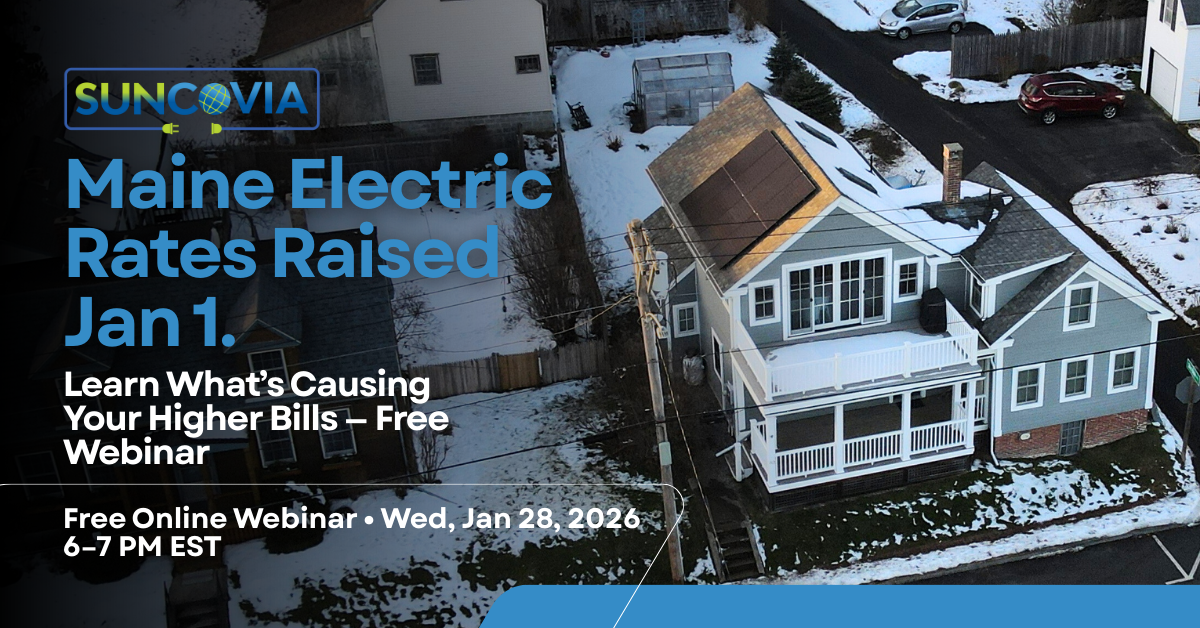
Join our free solar webinar to learn why Maine Utility Rates Are Rising in 2026: and discover strategies, including solar options, to manage higher electricity bills.
Maine homeowners are already seeing higher electric bills in 2026, and several factors are driving these increases. Infrastructure upgrades, supply charges, and stranded costs are major contributors to rising monthly bills, and many households are paying more for electricity even without using more energy. Maine Utility Rates Are Rising in 2026: and understanding why is critical if you want to protect your household budget.
To help homeowners get clear information and actionable guidance, Austin Goodwin, Sales Director at Suncovia, a local solar company with offices in Bangor and Westbrook, is hosting a free solar webinar on Wednesday, January 28th at 6:00 PM. Austin brings over a decade of experience helping Maine homeowners understand energy costs and explore solar solutions. He will explain what changed at the start of the year, why utility rates continue to rise, and what it means for households across the state.
Why Your Electric Bill Went Up
State regulators approved new “Standard Offer” electricity supply rates for Maine’s two major utilities, Central Maine Power (CMP) and Versant Power, and these increases went into effect on January 1st, 2026.
Here’s what that means for a typical Maine household:
-
Supply costs have increased. The standard offer electricity supply rate for CMP customers increased from about 10.61¢ per kWh in 2025 to 12.72¢ per kWh in 2026, and residential Versant Power customers also saw notable increases. These standard offer supply rates are a significant component of your monthly electric bill. Maine Utility Rates Are Rising in 2026: and supply charges are a key factor.
-
Infrastructure, supply charges, and stranded costs contribute. Transmission and distribution upgrades, along with stranded costs that include recovery for past energy programs, add further pressure to total electric bills. Maine Utility Rates Are Rising in 2026: due to these ongoing infrastructure costs.
-
Average bills are higher. Most residential customers in Maine can expect to pay roughly $12 to $16 more per month due to these changes.
Maine Utility Rates Are Rising in 2026: because the total cost of electricity now includes higher supply charges set through the state’s competitive bidding process and ongoing infrastructure and service costs.
What You’ll Learn in the Webinar
In this free solar webinar, Austin will explain:
-
What changed on January 1st, 2026 and why utility rates are rising
-
How infrastructure upgrades, supply charges, and stranded costs affect your monthly bill
-
What to expect from CMP and Versant in the coming months
-
Practical steps you can take now to protect yourself from ongoing increases
-
Long-term energy options, including solar solutions from Suncovia, that can help stabilize energy costs and reduce dependence on utility rate hikes
Whether you’re budgeting for the future or just trying to make sense of Maine Utility Rates Are Rising in 2026: this webinar is designed to give you clarity and direction.
How Solar Can Help Stabilize Costs
Thousands of Maine homeowners have already gone solar with Suncovia and are enjoying more predictable energy bills. Solar allows you to generate electricity on your own roof, reducing the amount you buy from the utility and helping protect you from future rate increases. It’s a practical way to take control of your energy costs while making a clean energy investment for your home.
Take Control of Your Energy Future
With electricity rates already higher since January 1st, 2026, now is the time to take action. Join our free solar webinar on Wednesday, January 28th at 6:00 PM to learn how you can protect your household from rising costs and explore energy solutions that provide more stability and control.
Register here: Suncovia Maine Energy Webinar
Stay informed, plan ahead, and see what options are available for your home in Maine as Maine Utility Rates Are Rising in 2026: continue to affect households statewide.